
All the below books are available on Amazon
Jiuta Sōkyoku Lyrics and Explanations–Songs of the Floating World

The publication of Jiuta Sōkyoku Lyrics and Explanations: Songs of the Floating World, was released in the Spring of 2024 by Routledge Press, under the imprimatur of the SOAS Studies in Music Series.
Jiuta Sōkyoku Lyrics and Explanations is a collection of translations and detailed explanations of seventy-three representative songs from traditional Japanese Edo-period ensemble music, known as sankyoku. These songs comprise the genre known as jiuta sōkyoku and were performed primarily on the shamisen and koto (oftentimes with shakuhachi accompaniment). These songs are still performed and loved in modern Japan.
The book begins with a detailed historical review of the jiuta sōkyoku genre and the various socio-political influences at work in its formation, followed by the translations and commentaries on the individual songs. The translations include the Japanese lyrics along with their Romanized transliterations, a direct word-for-word translation, a literary translation and contextual information and commentaries regarding musical and performative aspects of the song. The book also includes a substantive glossary and bibliography. Jiuta Sōkyoku Lyrics and Explanations guides the reader into a deeper understanding of this fascinating genre of traditional Japanese music and hopefully will be of interest to researchers, ethnomusicologists, Japanese studies scholars and poetry lovers who are interested in the literary and musical impact of the Edo period.
The book includes a number of color ukiyo-e prints, lent courtesy of the Honolulu Museum of Fine Arts Michener Collection. These stunning prints provide a visual reference to the thematic material of the song lyrics. The book also includes a link to five professional recordings of these songs. The book can be ordered through Amazon (a Kindle version is also available) or directly through the Routledge Press site.
Industry Reviews:
- April 4, 2025 London Times Literary Supplement here.
Booktopia:
“Christopher Yohmei Blasdel gives us a handsome publication that is more than just a translation of shamisen and koto songs (jiuta sokyoku) from 17th to 19th century Japan. For the English reader, this title adds a visual and literary appreciation to the sonic beauty of these songs. A combination of sensitive English imagery and insightful cultural commentary, its content is illustrated by a stunning series of woodblock prints related to the songs. In performance, the addition of shakuhachi (bamboo flute) enhances the aesthetic of the shamisen and koto performance. It seems therefore fitting that the author, an internationally known shakuhachi artist, enhances our understanding of these songs through this celebration of his lifelong engagement with them.”
The Single Tone—A Personal Journey into Shakuhachi Music

(C) Copyright 2005 Christopher Yohmei Blasdel. All Rights Reserved.
The English version of Blasdel’s award winning essay on learning shakuhachi in Japan (Shakuhachi Odyssey–see below) has been re-written for English language readers and is now available as an E-book on Apple Books or for Kindle on Amazon.
Originally published in 2005 as a paperback, The Single Tone—A Personal Journey into Shakuhachi Music is a highly perceptive and objective view of Japan’s culture and music written by a long-term American expat who lived most of his life in Japan. Christopher Yohmei Blasdel resided over 45 years in Tokyo and writes of his experiences studying, performing and teaching the traditional shakuhachi bamboo flute in Japan and around the world. He discusses the various legends surrounding the shakuhachi, its association with Zen Buddhism and the shakuhachi’s place in the Japanese culture. He also relates his personal encounters with various people, from renown artists, wealthy patrons, respected scholars to arrogant Japanese diplomats. His writings provide thoughtful insight into the Japanese mind and, through his world travels and performances in such diverse venues as the jungles of Guatemala, the ancient halls of the Republic of Georgia, and wind-swept Native American reservations in New Mexico, demonstrates the universal appeal of the shakuhachi. The E-Book edition has been updated with new photos.
Available from Amazon here.
Praise for The Single Tone:
“Shakuhachi music is honest, profound and beautiful. Blasdel has the passion and spirit that embodies these characteristics and is a pioneer who faces both the Japanese and world communities in order to invite others to participate in this extraordinary music. (Yokoyama Katsuya: shakuhachi performer, 1934-2010)
“Blasdel’s insights are a goldmine for culture studies and ethnomusicology scholars considering cross-cultural interactions and learning.” (Dr. Ricardo Trimillos: Professor Emeritus, University of Hawai’i)
“In The Single Tone, Blasdel explores the contradictions inherent in the study of traditional Japanese music by an outsider. He demonstrates that humanity supersedes even the strongest cultural barriers when philosophy and love of music are the guides.” (Brian Ritchie: Violent Femmes bassist, shakuhachi performer)
Blasdel’s love and passion for the shakuhachi permeates the work, but the most interesting aspects about this book are the observations on the Japanese culture. (Asahi Shinbun newspaper)
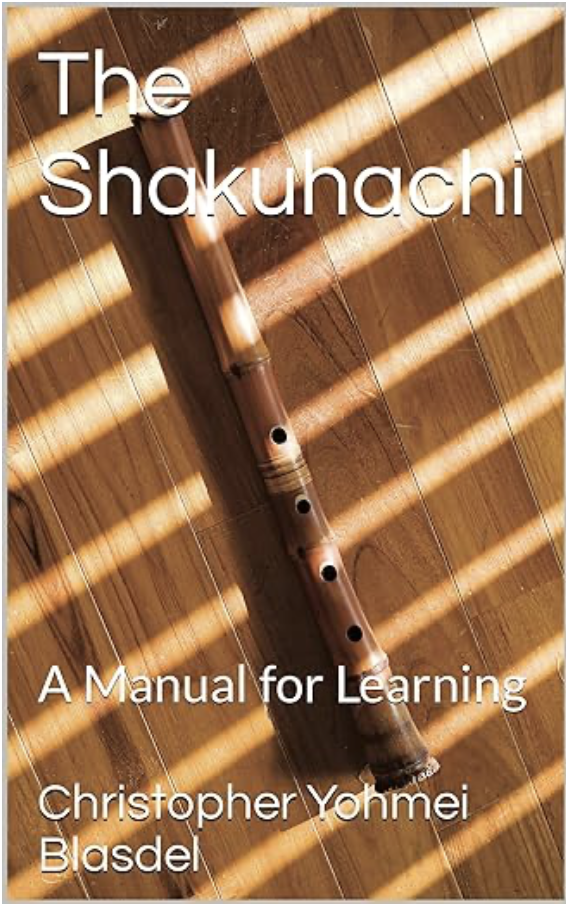
The Shakuhachi, A Manual for Learning
 (C) Copyright 2024 Christopher Yohmei Blasdel.
All Rights Reserved.
The e-book version of The Shakuhachi, A Manual for Learning, one of the first comprehensive English-language shakuhachi instruction books, is now available on Amazon Kindle at the significantly reduced price of $9.99. Originally published in 1986 by Ongaku no Tomo-sha, Japan’s leading music press, The Shakuhachi has undergone numerous editions and helped many beginner and intermediate players learn more about the instrument and how to play it. This book covers all the basic aspects of learning the shakuhachi, beginning with a chapter on bamboo and shakuhachi making, how to handle the instrument, tone production, as well as basic fingering and Kinko style ornamentation techniques. Also included in the book are a series of graduated shakuhachi practice exercises, from simple tunes to some of the lofty classical sankyoku pieces. These exercises, along with recorded examples, are also available for free download.
Available from Amazon here.
Shakuhachi Odessei
 Copyright 2001 Christopher Yohmei Blasdel.
All Rights Reserved.
This book, which was awarded the 6th Rennyo Award for non-fiction writing in Japan, describes the author’s arrival in Japan, the meeting and long years of tutelage under shakuhachi master Goro Yamaguchi and encounters with artists like the sculptor Isamu Noguchi and ethnomusicologist Fumio Koizumi. A chapter on the history of the shakuhachi sheds light on some of the myths concerning the instrument and the meaning they hold for the present day. There is also much written about the present day system of music education in Japan and the author’s peregrinations about the world performing shakuhachi and Japanese music. The English version is called “The Single Tone, A Personal Journey into Shakuhachi Music.
Sold Out
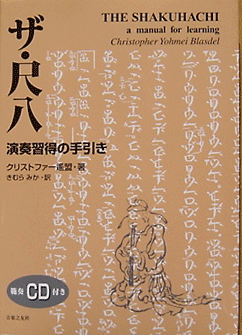
Za Shakuhachi, Ensou Shutoku no Tebiki
(C) Copyright 2001 Christopher Yohmei Blasdel. All Rights Reserved.
Japanese translation of “The Shakuhachi, A Manual for Learning.”
Japanese edition.