
All below CDs can be heard and purchased at Christopher Yohmei’s Bandcamp page:
An Ocean of Time features the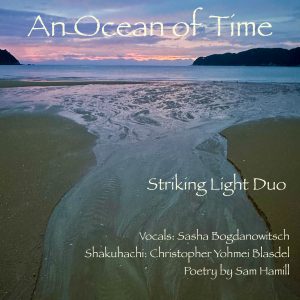 Striking Light Duo’s song renditions of poetry by Sam Hamill (1943-2018) , accompanied by the shakuhachi and an array of various world, folk and original instruments including the banjo, mountain dulcimer, halo, kamelengoni, mbira array and percussion.
Sam Hamill was one of the most important poets of 20th Century America. Giving up a wayward life to become a poet, Sam was a lifelong pacifist, steeped in Zen Buddhist discipline and ideology. He referred to his work as song rather than poetry, since poetry emphasizes the printed word, whereas song springs from the human act of entering the word. The songs in this album are accompanied by the shakuhachi and an array of rare world and original instruments. The shakuhachi blends with the fluid voice creating music that stimulates both on an artistic and intellectual level.
Striking Light Duo consists of shakuhachi bamboo flute master Christopher Yohmei Blasdel and vocalist/multi-instrumentalist Sasha Bogdanowitsch, both of whom have spent decades refining their respective musical styles. Their music is informed by a deep understanding and appreciation of world music while remaining grounded in the love of sharing their artistry.
 Striking Light, Striking Dark
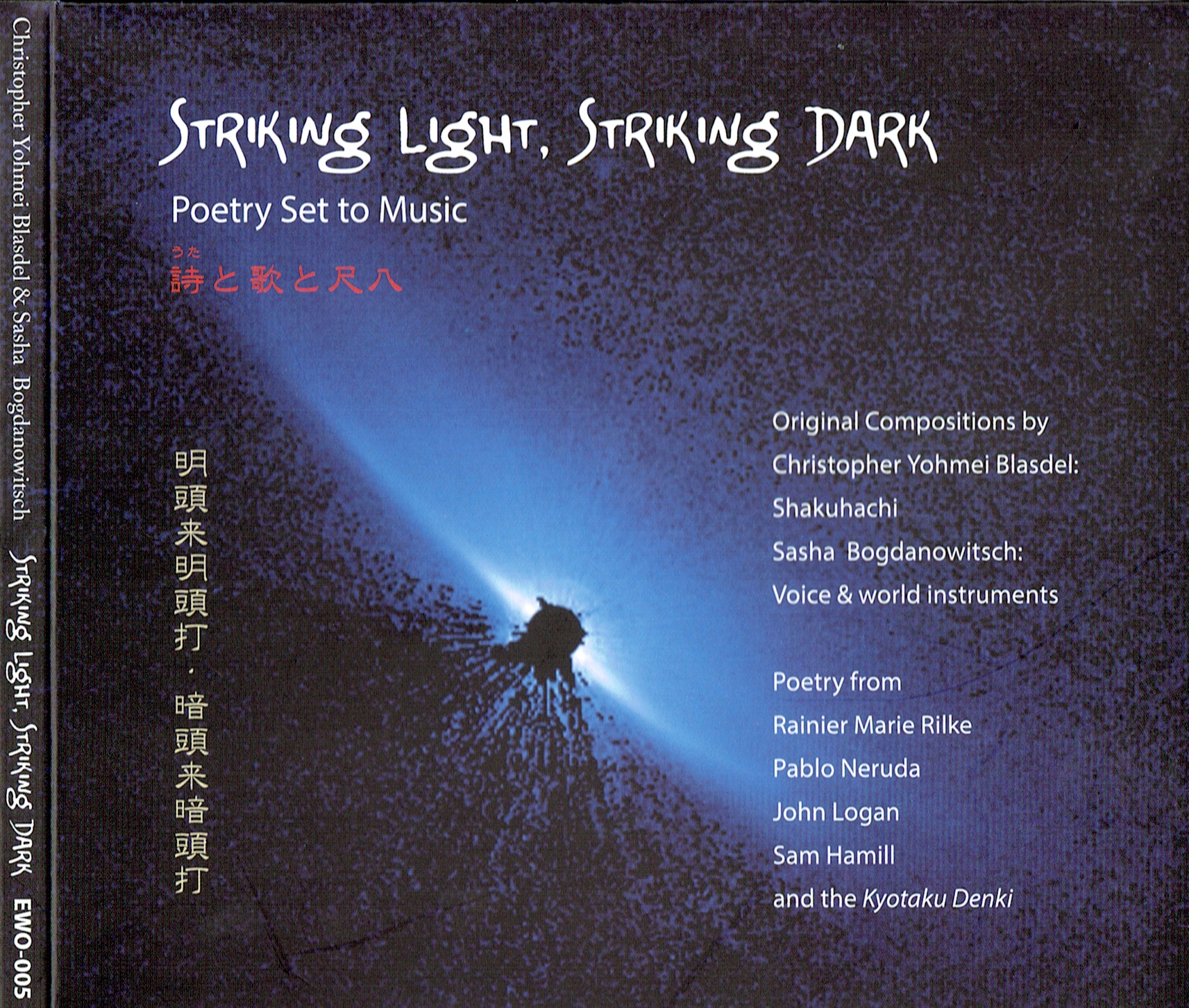
Poetry sung to original compositions by Sasha Bogdanowitsch (Voice) and Christopher Yohmei Blasdel (Shakuhachi). Poetry from the works of Ranier Maria Rilke (Germany), Pablo Neruda (Chile), John Logan, Sam Hamill (American), and the ancient Japanese Zen-inspired text, Kyotaku Denki.
We are proud to announce the release of our new CD, Striking Light, Striking Dark. Shakuhachi master Christopher Yohmei Blasdel collaborates with the phenomenal singer Sasha Bogdanowitsch to create new compositions that cross the boundaries of culture, style, time, the written word, and song. These two musicians set to song and instrumental accompaniment the poetry of legendary poets from four continents that span several centuries. The shakuhachi— Japan’s traditional vertical bamboo flute—makes the perfect blend of Sasha’s fluid voice. They also use an array of rare world and original instruments, such as the Pantheon Steel Halo, Freenotes metallophone, and Mbira Array along with the African dosongoni and karimba, to dramatize and enrich the songs. This CD is a perfect example of cross-genre, cross-cultural music that stimulates both on an artistic and intellectual level.
Track list (The poems and permissions can be found here)
- Ish Province Work Song (Sam Hamill)
- How Could We Forget? (Ranier Maria Rilke)
- Unity (Pablo Neruda)
- Solstice (Sam Hamill)
- Peacock Feather (Ranier Maria Rilke)
- Elegy (Sam Hamill)
- All of It (adapted from David Wagoner, Who Shall be the Sun?)
- Oracular (Sam Hamill)
- The Art of Literary Translation (Sam Hamill)
- The Search (John Logan)
- Kyorei (from the Kyotaku Denki)
- Saltarello instrumental
Navarasa
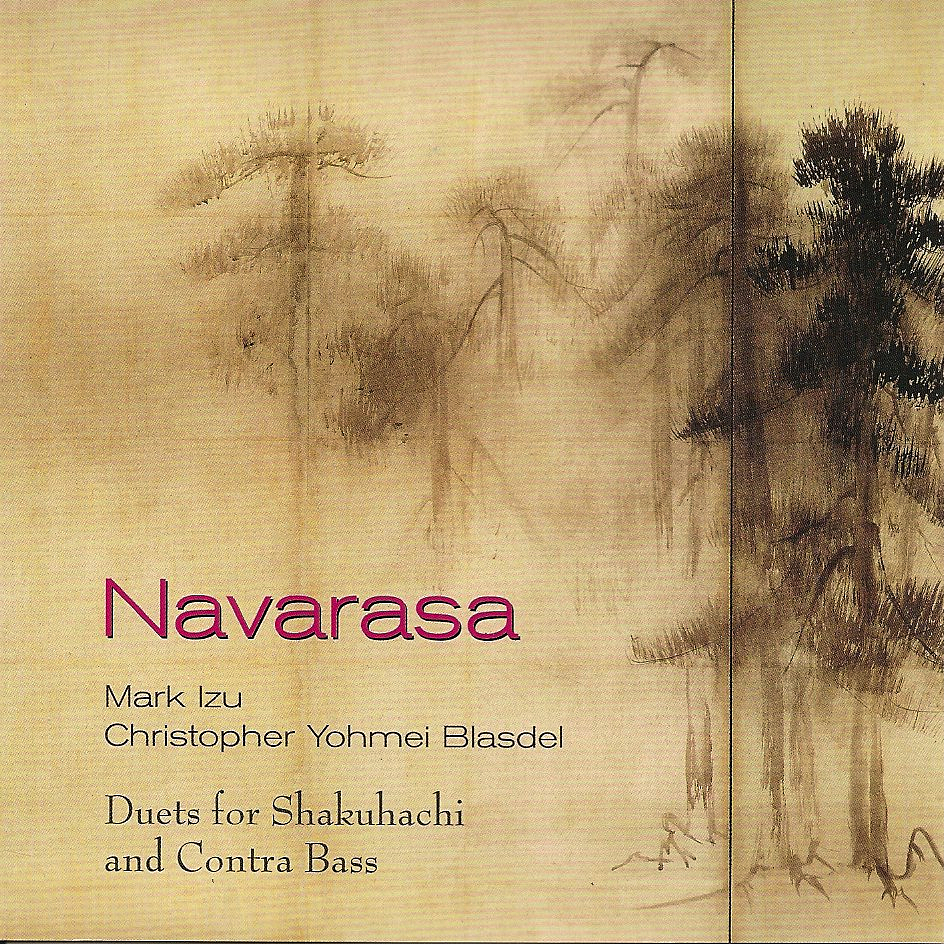
Shakuhachi: Christopher Yohmei Blasdel
Bass, Shô, Sheng: Mark Izu
All compositions by Christopher Yohmei Blasdel & Mark Izu
This CD is based on the navarasa (the nine basic human emotions written in ancient Sanscrit and given life through classical Indian dance) expressed through a combination of shakuhachi, bass, and mouth organ (the Chinese sheng and Japanese shô). The performers on this CD are Christopher Yohmei Blasdel, an American who has lived most of his life in Japan studying Japanese music, and Mark Izu, a Japanese American who has spent his life on the American west coast as a jazz artist and composer deftly utilizing aspects of traditional Asian music. The music is mostly improvised, based on the various rasa themes.
- Love (Śṛngāram)
- Interlude for Sita
- Mirth (Hāsyam)
- Compassion (Karuṇam)
- Arjuna’s Laugh
- Fury (Raudram)
- Ganesha’s Walk
- Heroism (Vīram)
- The Visage of Shiva
- Fear (Bhayānakam)
- Dance for Hanuman
- Disgust (Bībhatsam)
- Wonder (Adbhutam)
- Sita’s Return
- Tranquility (Shanta)
- Bass Solo
- Shiva’s Dance (shakuhachi solo)
Visionary Tones

Christopher Yohmei Blasdel.
Two CD Set of Traditional and Contemporary Kinko Style Shakuhachi Music (originally 2 CD set)
- Sokaku Reibo (Song of the Cranres)
Kinko Style Honkyoku - Yugure no Kyoku (Evening Song)
Kinko Style Honkyoku - Shigure, Kagero, Katsuragi
Takahashi Yuji - Sagari Ha no Kyoku (Song of the Falling Leaves)
Kinko Style Honkyoku - Tsuki no Kyoku (Song of the Moon)
Kinko Style Honkyoku - Byoh–for Shakuhachi Solo
Hirose Ryohei
Breathplay
Christopher Yohmei Blasdel & Byron Au Yong
- Water Whispers
- San’ya
- Elephant
- BreathPlay
- Cricket
- Mist
Collaborative CD with Seattle-based composer Byron AuYong. Shakuhachi with water, voice, er-hu (Chinese fiddle), piano and an assortment of Asian percussion in a recording that pushes past the traditional and avant-garde to music both ancient and contemporary.
Heart of Bamboo
Shakuhachi: Christopher Yohmei Blasdel
Koto: Elizabeth Falconer
Poetry Reading: Sam Hamill
- Heart Of Bamboo
- Waka from Only Companion
- Song of the Dream Garden
- Shunga
- After Han Yu
- Talking to Myself
- True Illumination
- A Lover’s Quarrel
- Midsummer
- Four Letters to Hayden Carruth
Zen Reveries
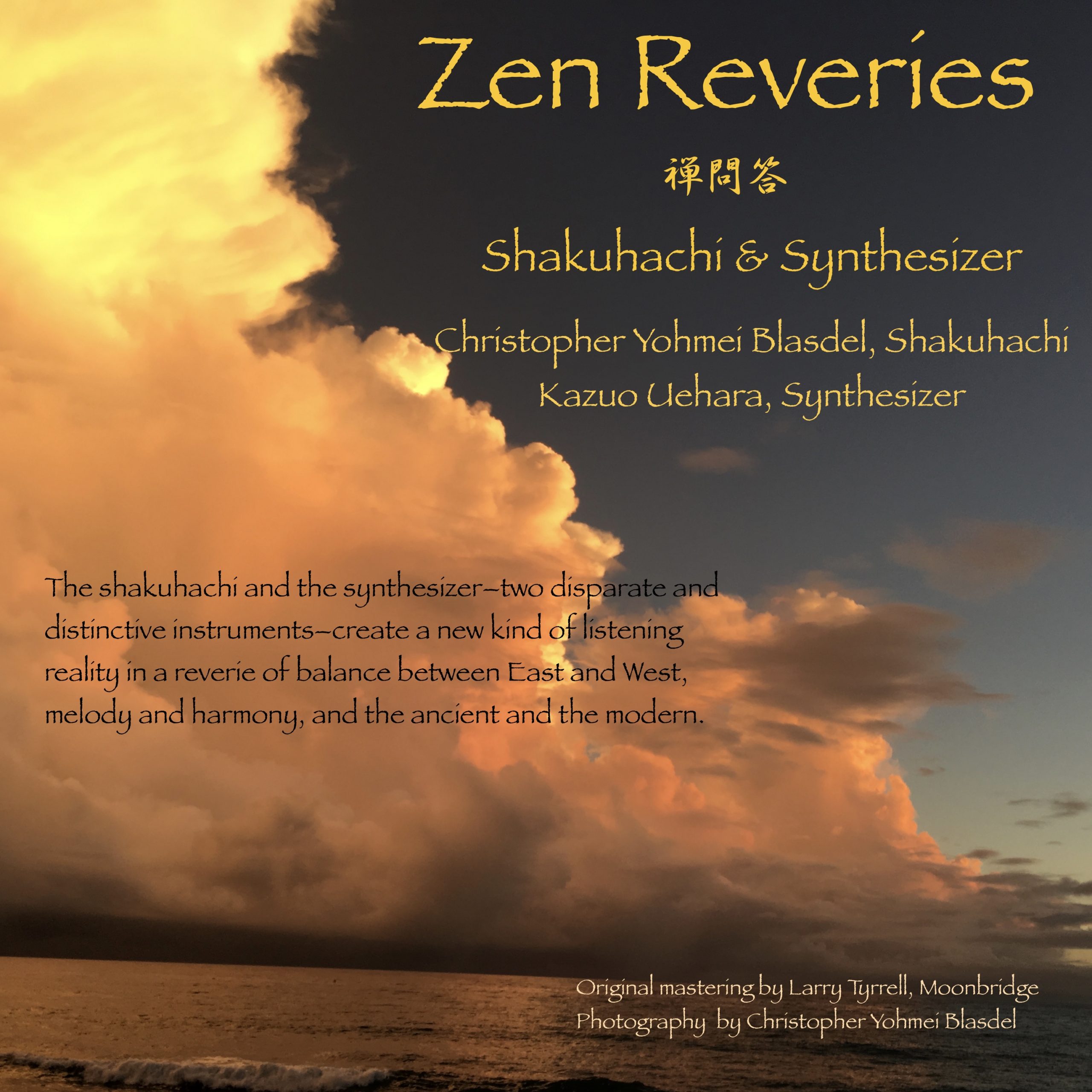
Zen Reveries
Shakuhachi: Christopher Yohmei Blasdel
Synthesizer* Kazuo Uehara
- Another Kind of Dream
- Gendai Choshi
- Pale Lights
- Morning Becomes Electric
- Replay
- Zen Mondoh
All compositions by Christopher Yohmei and UEHARA Kazuo, except* Gendai Choshi by Christopher Yohmei Blasdel: Shakuhachi, Kazuo Uehara: Synthesizer
Night of the Garuda
N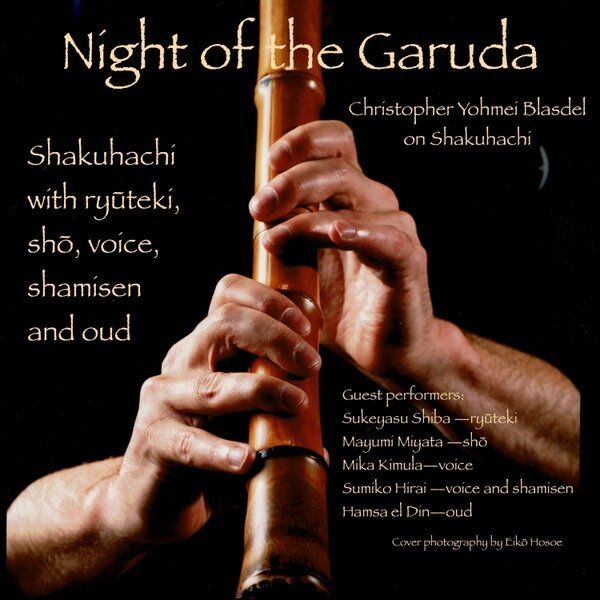 ight of The Garuda improvisation for shakuhachi and ryuuteki
Composed by Christopher Yohmei and Sukeyasu Shiba
Tsuki, for shakuhachi and sho, composed by Kikuko Massumoto
The Song of Atitlan, for shakuhachi and soprano
Composed by Christopher Yohmei and Mika Kimula
Hi-fu-mi Hachigaeshi Shirabe
Kinko style honkyoku
Mama no Kawa, for shamisen and shakuhachi, composed by Kikuoka Kengyō